
Segger Flasher Performance
SEGGER Flashers are the fastest in-system programmers in the industry.
1. Flasher Top-Speed Guarantee
2. What makes SEGGER Flashers so fast?
3. Sample programming speeds
4. How programming speed is measured at SEGGER

Maximum Programming Speed in Practice
SEGGER Flashers are optimized for both flexibility and maximum programming speed across a wide range of target devices and interfaces. Their architecture combines highly efficient firmware, tightly integrated software components, and advanced programming algorithms to deliver consistently superior performance in real-world applications.
SEGGER guarantees that their Flashers are faster than any other in-system programmer on the market.

Flasher Top-Speed Guarantee
If a competing programmer outperforms Flasher in an identical real-world use case in terms of speed, then SEGGER will analyze the scenario and identify the limiting factors.
Targeted improvements will then be implemented, such as firmware updates, algorithm refinements, or configuration adjustments, to close the performance gap.
If this cannot be achieved, a full refund is granted within six months of purchase under the terms and conditions of the guarantee.
This approach reflects SEGGER’s commitment to measurable performance and continuous improvement.
The goals are to keep pace with the fastest solutions available, to continuously define the benchmark for programming speed, and to ensure that SEGGER customers always have the fastest in-system programmers on the market - guaranteed.
What Makes SEGGER Flashers So Fast?
Hardware Architecture Optimized for Maximum Speed
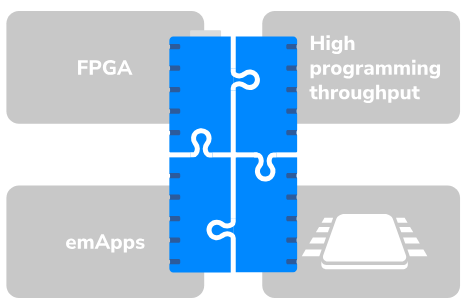
SEGGER Flasher hardware is purpose-built for high performance, combining specialized components with a flexible architecture to deliver leading programming speed:
- High-speed SoC with integrated FPGA logic for accelerating critical operations
- Dedicated interface processors for fast, parallel communication with target devices
- Architecture optimized for high programming throughput
- Highly efficient virtual CPU based on emApps, enabling flexibility without compromising performance
Highly Efficient Firmware
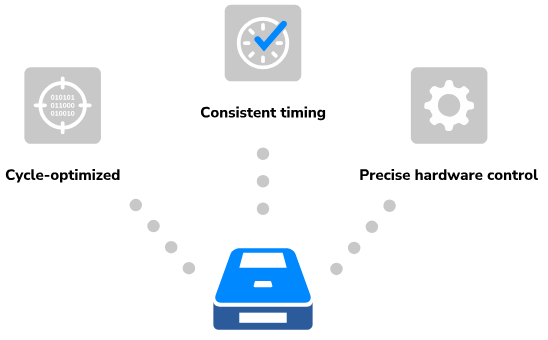
SEGGER Flashers run firmware specifically designed for high-throughput programming.
- Cycle-optimized code paths reduce instruction overhead
- Deterministic execution ensures consistent timing
- Low-level hardware control enables precise tuning for each target
- Minimal communication latency between host and programmer
Tightly Integrated Software Components
SEGGER's ecosystem is built from components designed to work together seamlessly.
- emPower OS, including embOS for responsive real-time task scheduling, emNet for efficient, low-overhead communication, and many other proven components for embedded systems
- emApps and internal stacks are optimized for throughput
This integration:
- Avoids redundant buffering and copying
- Reduces context-switch overhead
- Enables parallel handling of communication and programming tasks

Turbo Mode
Turbo Mode maximizes programming throughput by overlapping data transfer and flash programming. It enables SEGGER Flashers to outperform conventional sequential programming approaches.
- Enables parallel data transfer and programming
- Eliminates interface idle time
- Ensures continuous target utilization

Optimized Programming Workflow
SEGGER Flashers optimize the entire programming cycle, not just data transfer.
Smart Erase Strategies
- Sector-based or selective erase instead of full chip erase
- Avoidance of unnecessary operations
Intelligent Programming Algorithms
- Skipping unchanged data where possible
- Target-specific flash loaders for maximum efficiency
Efficient Verification
- Optimized routines such as block-based or CRC-assisted verification
- Balanced approach to speed and data integrity
Pipeline Execution
- Overlapping operations, for example preparing the next block while programming the current one

Sample Programming Speeds
Programming speeds very much depend on the target systems. Below are just a few examples of top programming speeds achieved with SEGGER Flashers. In each case the programming performance is at or near the maximum speed limit set by the target device.
The results highlight the system’s ability to achieve maximum throughput and minimize programming time. A SEGGER Flasher usually programs a target device at 90 to 100% of the possible speed of the target system. These results are achieved through SEGGER’s unwavering focus on performance, from start to finish.
QSPI NOR Flash - Indirect
| Device Series | QSPI Flash | Program |
|---|---|---|
| NXP MIMXRT595 | Macronix MX25UW51345G | 1086 KB / s |
| NXP MIMXRT685S | Macronix MX25UM51345G | 988 KB / s |
| NXP MIMXRT1052 | ISSI IS25WP064A | 865 KB / s |
| NXP MIMXRT1064 internal QSPI | Winbond W25Q32JV | 390 KB / s |
| NXP MK80FN256V15 | Macronix MX25U3235F | 362 KB / s |
| Renesas R7FA6M3AH | Macronix MX25L25645G | 954 KB / s |
| Renesas R7FS5D97E | Winbond W25Q64FV | 439 KB / s |
| ST STM32H757XI QSPI | MT25QL512ABB8ESF | 1080 KB / s |
| ST STM32L4R9AI QSPI | Macronix MX25LM51245G | 964 KB / s |
| ST STM32L562QE QSPI | Macronix MX25LM51245G | 1043 KB / s |
Internal Flash
| Device Series | Program |
|---|---|
| Infineon TC4D9XP-20MF500MC | 2273 KB / s |
| Cypress CYT2B98CAC_M0 | 988 KB / s |
| NXP LPC1857 | 431 KB / s |
| Renesas R7FA6M3AH | 398 KB / s |
| Renesas R7FS5D97E | 396 KB / s |
| ST STM32H735IGK | 364 KB / s |
How Programming Speed is Measured at SEGGER
Programming speed is not a theoretical value but a measurable result defined under controlled and reproducible conditions. At SEGGER, a consistent methodology is used to ensure that every measurement reflects real programming performance.
Speed is determined using a clearly defined setup:
Test Setup
- Target device on dedicated evaluation board
- Defined programmer (hardware model and configuration)
- Programming interface (e.g. JTAG, SWD, SPI)
- Fixed interface speed and protocol settings
- Execution mode (standalone or with host connection via USB or Ethernet)
Environmental Conditions
- Stable and defined power supply
- Controlled physical setup, including cabling and signal integrity
Programming Task
- Defined image size (full chip or specific memory region)
- Defined data pattern
- Selected memory type (internal flash or external memory)
This methodology ensures that all results are based on a known and repeatable scenario. It eliminates ambiguity and provides a reliable foundation for evaluating and improving programming performance.