
Residual Bus Simulation (RBS)
Residual Bus Simulation - or Rest Bus Simulation (RBS) - is used to simulate ECUs or parts of a vehicle. Normally you need to code it manually by means of a scripting language - but not with solutions from Ixxat. RBS is generated automatically by means of a vehicle description database you have defined with the integrated vehicle editor. All you need to do is to select the ECUs you want to simulate.
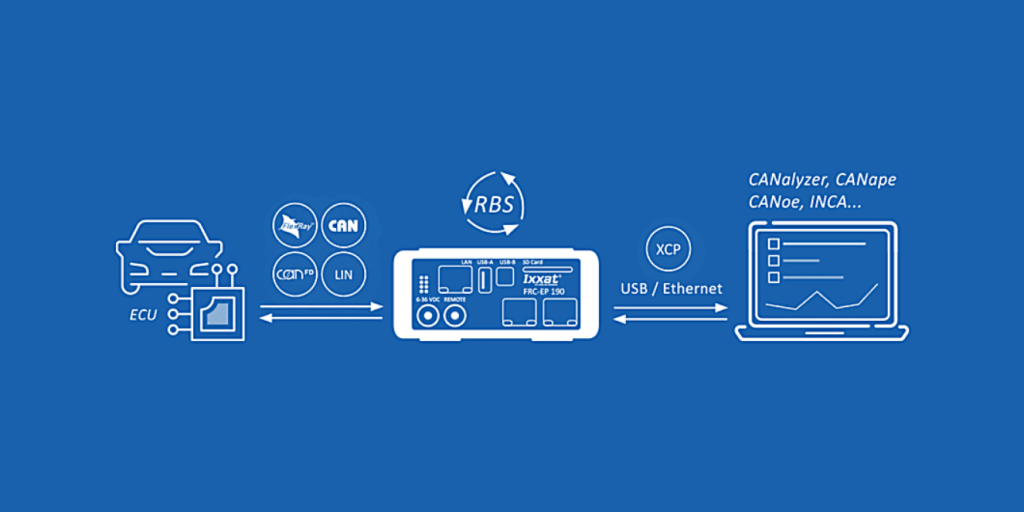
The following work is automatically done by ACT:
- Detecting which messages shall be sent
- Detecting which messages do contain CRCs or alive counters
- Generating the modules which do the CRC and alive counter calculation automatically
- Cross compile the generated C code and integrate it with highest performance into the rest of your testing configuration
All that is done with configuration wizards - there is no programming effort. You want to influence the RBS? No problem, just add your specific code or algorithm into the automatically generated modules. At the end, the complete configuration including your RBS is executed autonomously on the devices of the Mobilizer or FRC-EP series.
XCPonEthernet
You want to control or adjust the RBS executed on the Mobilizer or FRC-EP series device? For this, XCPonEthernet can be used to connect a third party software supporting this standard.
If needed, ACT generates a A2L description file containing all signals which are sent by the RBS/GW configuration being executed on the device. From the perspective of the third-party tool, the Mobilizer or FRC-EP series device is a virtual ECU. By means of the A2L virtual memory, locations containing the desired signals can be read or written. By doing so, you are able to influence everything that is sent on the different bus systems. This includes also the CRC and alive counters generated by the RBS or signals which a calculated by your user code being executed on the device.
HIL Signal Manipulation
Based on the FlexRay/CAN RBS and the XCPonEthernet extension, the signals sent by the RBS can be defined and manipulated. This includes, for example:
- On/off switching of signals for a defined time or number of cycles
- Transmission of defined substitute values with switched-off signals
- Defined corrupting of CRCs and alive counters
The control of the signal manipulation can take place via user code, the gateway or XCPonEthernet.